How Far in Advance Can You Make Fudge
F udge is probably the beginning thing I cooked without supervision – in fact, had the powers that be seen the states turning the school margarine and sugar supply into a molten mess, they might well have nipped our culinary experimentation in the bud.
The washing up that resulted proved a salutary lesson in the tricky business of confectionary – because, although fudge isn't a recipe with many steps, or indeed many ingredients, as with anything involving melted sugar, it is one that demands precision, attention to detail and, ideally, an actual recipe. Chucking a load of ingredients into the pan and hoping for the best doesn't actually wash here, however hard you scrub.
Softer and crumblier than toffee, smoother and richer than its close relative, tablet, its dairy content ways fudge is associated peculiarly with the southward-west, though shops churning it out in a heed-extraordinary array of weird and only occasionally wonderful flavours are de rigueur in tourist honeypots throughout the British Isles. But earlier you can hope to achieve gingerbread latte-flavoured nirvana, you lot need a decent basic template. Which is where I come up in.

The saccharide
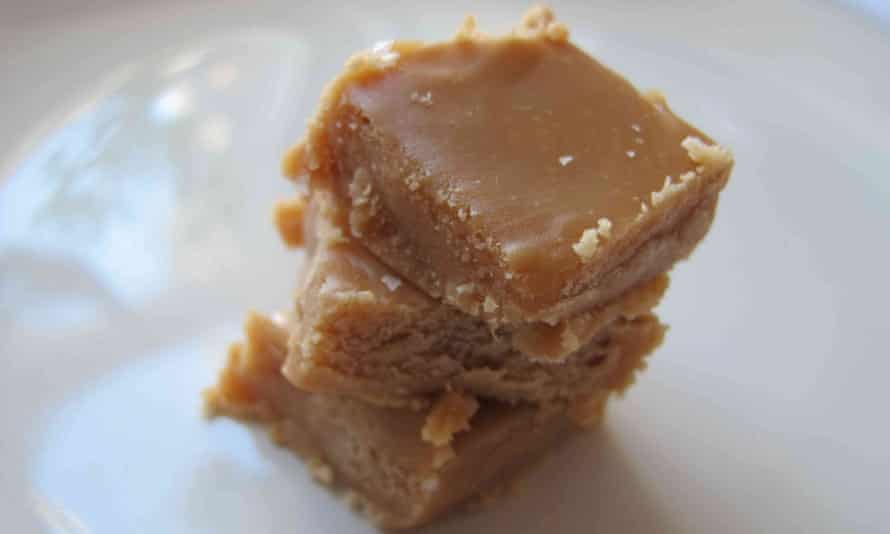
Lest anyone was nether whatsoever illusions in this department, the chief ingredient of fudge is carbohydrate – that's why y'all can experience your teeth wince in protest as you accomplish for yet some other piece. If y'all want to continue things simple, similar candy pros Mrs Promise and Mr Greenwood, the folk from Rodda's clotted foam and Michelin-star chef Tom Aikens, this can be caster or ordinary white granulated, but given sugar plays such a large part, the demerara suggested by the Carnation condensed milk tin or the light muscovado used by Ren Behan in Jamie magazine will give a more interesting flavour. Personally, I prefer the slightly more than subtle caramel notes of the get-go hither.
Aikens and Roddas both besides add some sugar syrup – deadening glucose in the former example, ambrosial golden in the latter – which makes their fudge wonderfully shine as opposed to the slightly gritty, sandy texture of the Carnation and Hope and Greenwood recipes, which, though undoubtedly pleasing, is more reminiscent of Scottish tablet. Clearly feeling two types of sugar aren't quite enough, Aikens finishes his fudge with an infinitesimal corporeality of icing saccharide, for, no doubtfulness, very sound Michelin-starred reasons which I am unable to fathom.
The dairy
The 2nd, and most important, ingredient in fudge is fat. Dairy fat to be precise. Some recipes cleverly combine the two ingredients in i big hit of nauseatingly delicious condensed milk, which makes their fudge taste distinctly like white chocolate – not that there's anything wrong with this, but it's not the classic flavor I'm later on.
Hope and Greenwood plump for the nostalgic boiled flavour of evaporated milk instead, an ingredient that has and so far failed to reinvent itself for a more decadent age. Despite a weird complaint that it tastes "compact", I happen to like it, only not every bit much as the clotted cream which plays an unsurprisingly large part in the Roddas recipe, or the double variety in Aikens's fudge.
In fact, the Roddas recipe proves pretty popular; soft, smooth and rich, it'due south classic Cornish seaside stuff. My only complaint is that the flavour is a petty too sweet and rich, which I admit may sound ridiculous, but in a side-by-side comparing, we preferred those recipes using butter also. Allow'due south be honest, everything'due south better with butter. But, every bit butter and clotted foam could prove a fatal combination, a downgrade to double seems just what the doc ordered.
The flavouring
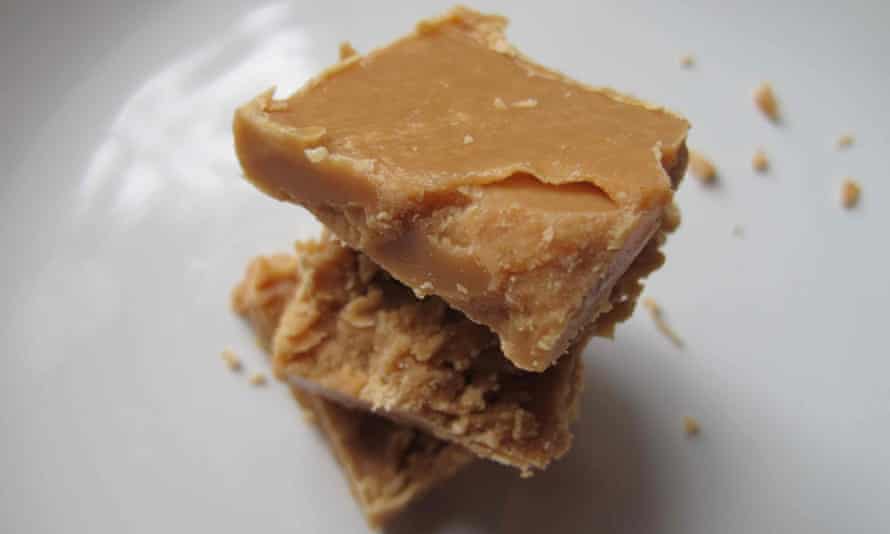
Though to make this a off-white test I omit Hope and Greenwood'southward peanut butter (annihilation containing peanut butter is always going to win big for me), I do let Roddas, Behan and Aikens their vanilla. Not strictly necessary for a satisfactory result, just a lovely combination of flavours yet – and this is one identify where I think vanilla extract works improve than those fiddly niggling seeds. Salt is another must – equally ever, it brings out the all-time in the sugar, keeping information technology simply the right side of sickly. How much you add depends on how enthusiastically you accept embraced salted caramel mania over the last few years; sceptics will be content with a pinch, salt fiends like myself should up the dosage considerably. In for a penny, in for a pound.
The method
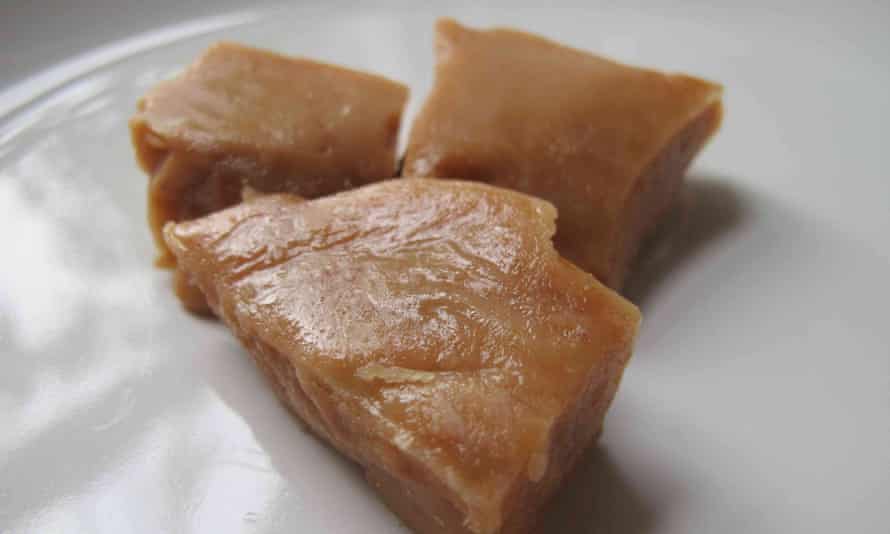
All the recipes I endeavor outset in much the same manner, dissolving the sugar and dairy together over heat, bringing the resulting mixture to the boil, and then letting it simmer until it reaches the desired setting temperature. (Covering the pan, as Roddas suggest, works fine, just feels a bit scary to me; I adopt to continue my molten sugar where I tin can come across it.)
The difference comes in temperature, which ranges from 113C from Behan, which gives a very soft, almost fondant-like result, to Aikens'southward 121C, which is brittle and chewy, more similar a hard caramel than a fudge. Even Hope and Greenwood and Carnation's 118C is a flake harder than I had expect from a fudge – my testers and I agree that Roddas accept hit the sugariness spot at 116C: firm enough to concord its shape, soft enough to cook in the mouth.
Lots of recipes requite advice virtually how to achieve this without a saccharide thermometer (dropping a fiddling into a glass of cold water until it reaches a pliable consistency), but this is a fiddly and inexact science, so I'd recommend investing in a sugar thermometer. They're not expensive, and they'll work forever (though be careful when washing as they tin be delicate).
Stirring?
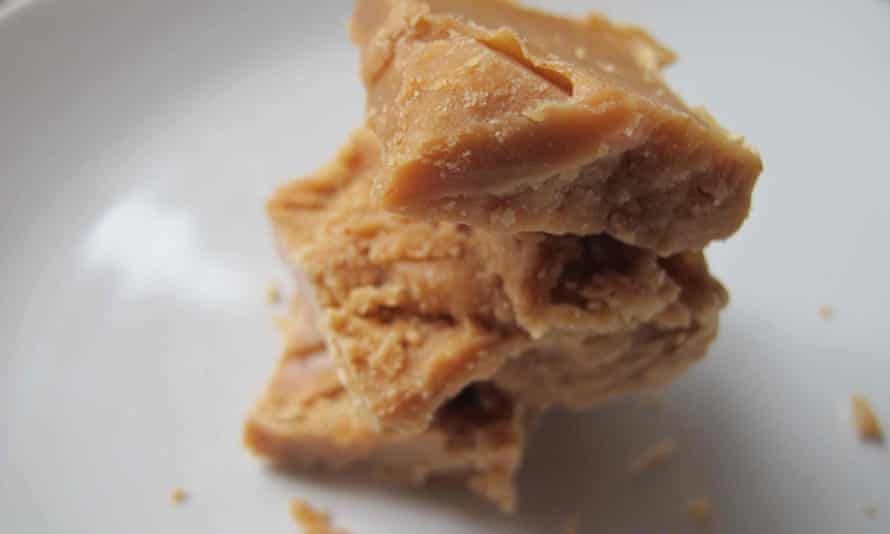
Fudge, like tablet, is beaten equally it cools to help information technology thicken. Behan suggests allowing it to cool a little before doing this, but I can't meet that it makes much divergence, apart from making it dangerously tempting to sample (yet not a good idea, however tough you think your natural language is). Once it's ready completely, however, it's every human being for himself. I cannot be held responsible for the consequences. Add chopped nuts, dried fruit, crisp nuggets of streaky bacon … your call.
The perfect fudge
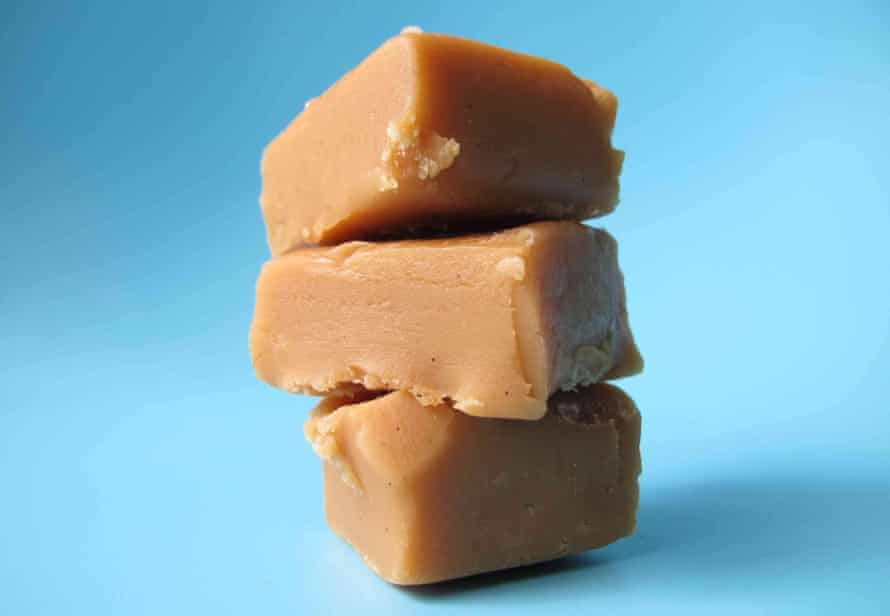
(makes 1 x 23x23cm tin)
100g butter
550g demerara sugar
200g golden syrup
350ml double foam
ane tsp vanilla extract
¼-½ tsp bounding main salt flakes
Melt the butter, carbohydrate and syrup and foam in a medium, high-sided heavy-based pan, stirring until the sugar has dissolved. Line a tin nearly 23x23cm with greaseproof paper.
Bring to a simmer over a medium-low heat without stirring and cook, stirring occasionally until it reaches 116C, stirring more than regularly after information technology reaches 100C and turning down the rut if it begins to catch.
Take off the heat and shell in the vanilla and salt with a wooden spoon, and so continue chirapsia until the fudge has thickened and lost its shine. Pour into the tin can and exit to set up.
Once it's firmed up a little, afterward about an hour, slice into squares and leave to absurd completely. All-time kept refrigerated.
Fudge, tablet, toffee or caramel: where practise your sugary loyalties lie? What's your favourite season, and who makes the best y'all can buy?
brannonvirinarlecou.blogspot.com
Source: https://www.theguardian.com/lifeandstyle/2015/jun/11/how-to-make-the-perfect-fudge-felicity-cloake
0 Response to "How Far in Advance Can You Make Fudge"
Post a Comment